 AntiDetect Rank
Glossary · Network & proxies
Residential proxy
A proxy whose exit IP belongs to a consumer internet connection rather than a datacenter.
Definition
In HTTP terms, a proxy is an intermediary the client chooses to forward its requests (RFC 9110). "Residential proxy" is not a standards term; it is an industry label for proxies whose exit addresses are assigned by consumer ISPs to home or mobile connections. Providers such as Bright Data describe routing traffic through real devices whose owners opted in to the network.
How it works
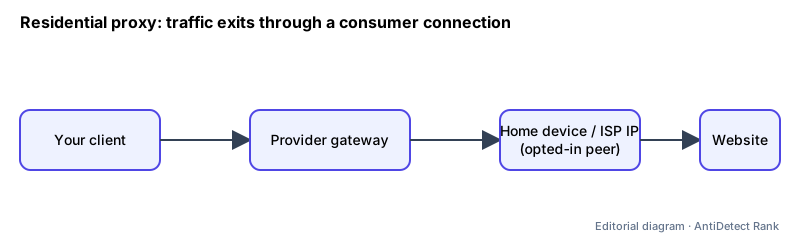
- You connect to the provider's gateway with credentials; parameters in the username or port usually select country, city or session behaviour.
- The gateway forwards your request through a participating residential device, so the target site sees that device's ISP IP.
- Rotation and session length are provider features: some rotate on every request by default, others offer sticky sessions.
Why it matters
- Sites often treat datacenter IP ranges with more suspicion than consumer ISP ranges, so residential exits are used for localized price checks, ad verification and market research.
- Antidetect browsers pair each profile with a proxy so the IP location matches the profile's timezone and language.
Limits and common misconceptions
- "Residential means anonymous." The provider still sees your traffic and account, and sites can still use fingerprints and behaviour.
- "All residential networks are sourced the same way." Sourcing and consent models vary by provider — read the provider's own disclosures.
Example: A retailer checks how its product page appears in Lyon by sending requests through a residential exit in France, then compares localized prices and language.
No browser or proxy can guarantee that accounts will not be restricted. Follow each platform's rules.
Related terms
- Sticky session (proxy) — A proxy setting that keeps the same exit IP across consecutive requests for a period of time.
- WebRTC leak — When WebRTC reveals an IP address that differs from the proxy or VPN address a site otherwise sees.
- Timezone and geolocation mismatch — When the location implied by a connection's IP address disagrees with the browser's time zone or reported coordinates.
- Browser profile — A separate set of browser data — cookies, history, settings, extensions — kept apart from other profiles.
Sources
- IETF RFC 9110: HTTP Semantics (intermediaries) (standard)
- Bright Data docs: Introduction to Residential proxies (vendor docs)
Checked 2026-11-07.